
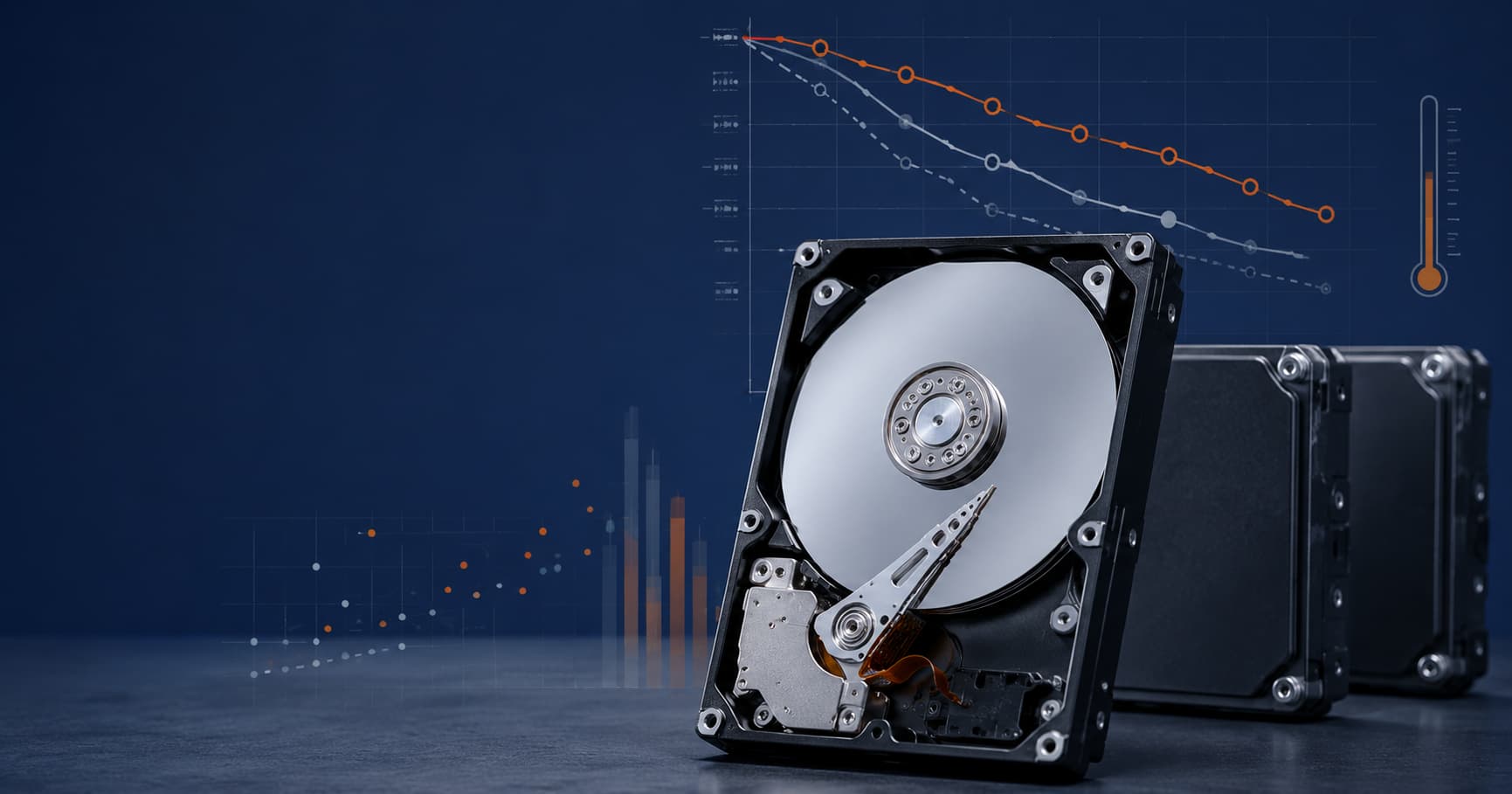
Choosing a hard drive based solely on the manufacturer’s name can be tempting. However, a large hard drive reliability study shows why buyers should look beyond simple brand rankings and raw failure totals.
Researchers Christoph Siemroth and Yeomyung Park reanalyzed 12 years of public data from Backblaze, a cloud storage provider that publishes operating statistics for drives in its data centers. The peer-reviewed study covered 443,156 hard disk drives and approximately 1.66 million drive-years.
After accounting for important differences among the drives, the researchers found meaningful variations between manufacturers. The findings offer useful guidance, but they do not identify a universally “best” hard drive for every home or business.
How the Study Improved on Raw Failure Rates
A basic failure rate can be misleading when the drives being compared are not equivalent. One manufacturer’s drives may be older, smaller or operating under different conditions than another manufacturer’s products.
The researchers used two statistical models to compare HGST, Seagate, Toshiba and Western Digital drives while controlling for:
- Drive age and installation year
- Storage capacity
- 2.5-inch or 3.5-inch form factor
- Average operating temperature
This adjustment matters because the manufacturers’ drives entered Backblaze’s fleet at different times. Comparing unadjusted totals could make a manufacturer with an older installed population appear less reliable simply because more of its drives had reached a failure-prone age.
The resulting study, published in IEEE Transactions on Cloud Computing, therefore offers a more controlled comparison than a simple annual failure table. The accepted paper is available through the University of Essex Research Repository.
Adjusted HDD Reliability Results
Seagate served as the reference point in the analysis. Relative to Seagate’s estimated failure rate, the results were:
| Manufacturer | Adjusted relative failure rate |
|---|---|
| HGST | 41% of Seagate’s rate |
| Western Digital | 52% of Seagate’s rate |
| Seagate | 100% reference |
| Toshiba | 107% of Seagate’s rate |
HGST had the lowest estimated failure rate, followed by Western Digital. Toshiba’s estimated rate was approximately 7% higher than Seagate’s.
These numbers describe manufacturer-level averages within this particular dataset. They do not mean that every HGST drive is more reliable than every Seagate or Toshiba model. Reliability can vary substantially between individual models from the same manufacturer.
HGST also no longer exists as an independent new-drive brand after becoming part of Western Digital. Its results are still valuable for businesses operating older HGST drives or evaluating the reliability history of their existing storage systems.
Age and Temperature Also Matter
The analysis found a notable increase in Toshiba failures after approximately 60 months of operation. Between 50 and 100 months, Toshiba drives experienced roughly five to six failures per 1,000 drives each month. Other manufacturers generally remained at or below 2.5 failures per 1,000 drives per month.
That does not establish a universal five-year replacement deadline for every Toshiba drive. It does suggest that organizations using older drives should increase monitoring and make replacement decisions before failures begin disrupting operations.
Temperature was another significant factor. Each additional degree Celsius in average operating temperature was associated with an estimated 2.1% increase in failure risk. Proper airflow, clean equipment and working cooling systems can therefore contribute to storage reliability.
Higher capacity was associated with an approximately 3.4% reduction in failure risk per additional terabyte. Buyers should not conclude that capacity alone makes a drive safer, however. Newer high-capacity models may use different manufacturing processes, designs or deployment methods that also affect reliability.
What Buyers Should Prioritize
Backblaze operates drives continuously in data centers. Its inventory is not a randomized sample of every consumer, surveillance, network-attached storage or enterprise drive available. Workloads may also differ from those in a typical small business.
When choosing storage, consider:
- Reliability records for the specific drive model
- Whether the drive is designed for the intended workload
- Warranty length and replacement terms
- Operating temperature and ventilation
- A planned replacement schedule
- Redundant storage and dependable backups
Backblaze itself notes that failure rates vary among models from the same manufacturer and recommends regular backups, stable temperatures and drive-health monitoring. Its Drive Stats dataset is a useful research tool, but no reliability ranking can replace a sound backup strategy.
If your business needs help selecting storage, monitoring aging equipment or building a reliable backup plan, contact Illini Tech Services at 217-854-6260 or [email protected]. We help organizations throughout central Illinois protect their data and plan for hardware failures before they become emergencies.