
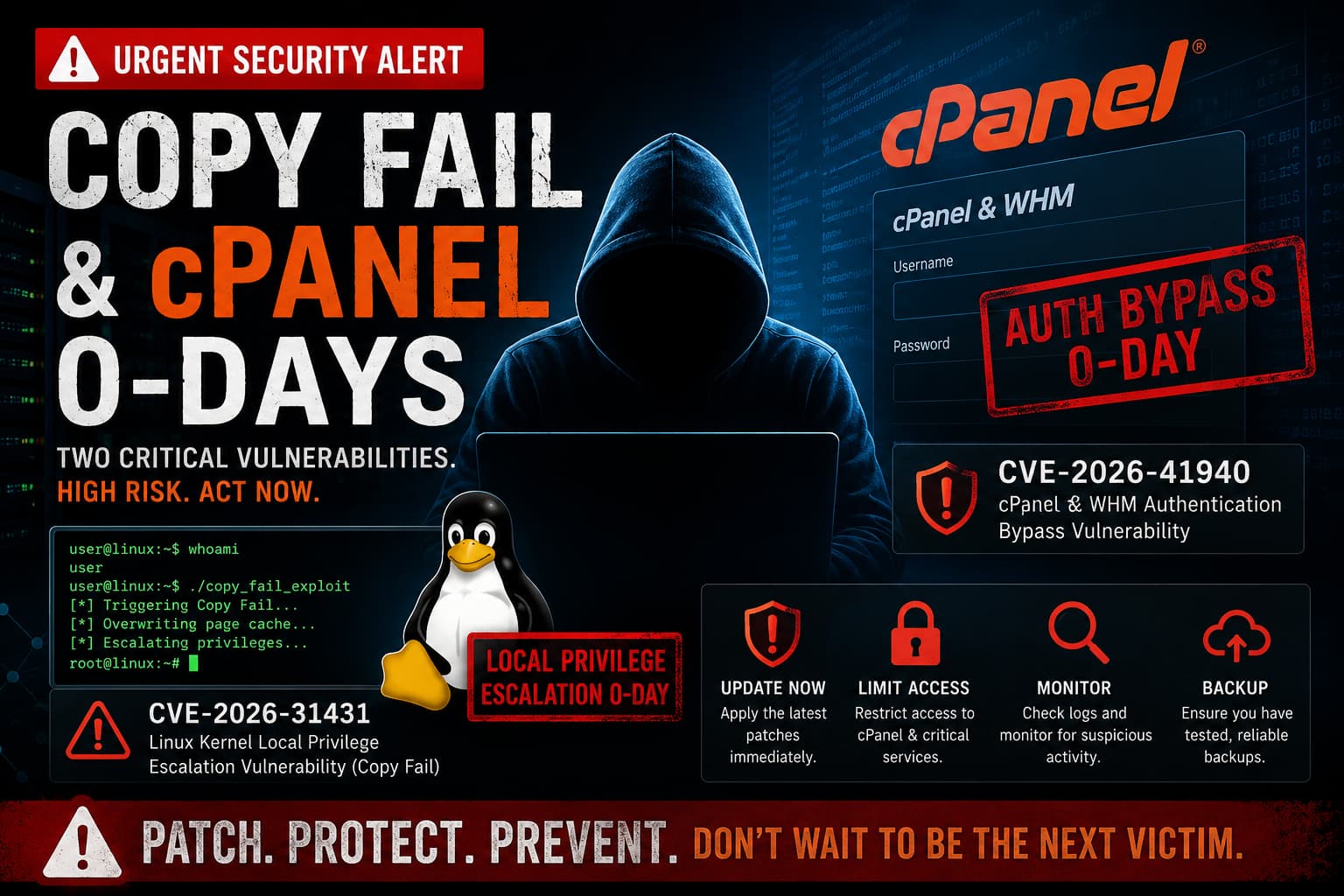
Two recent security issues, Copy Fail and CVE-2026-41940 in cPanel & WHM, are a strong reminder that web hosting security depends on more than website code. The server stack, control panel, Linux kernel, update policy, and exposure of administrative services all matter.
For businesses that rely on hosted websites, client portals, ecommerce, email, or cloud applications, these vulnerabilities are worth understanding. One affects Linux systems at the kernel level. The other affects cPanel & WHM, a widely used web hosting control panel. Both can create serious risk when servers are unpatched or poorly segmented.
What happened with cPanel CVE-2026-41940?
CVE-2026-41940 is an authentication bypass vulnerability affecting cPanel & WHM. cPanel’s advisory says the issue affects cPanel software, including DNSOnly, on versions after 11.40. NVD describes the flaw as a login flow authentication bypass that can allow unauthenticated remote attackers to gain unauthorized access to the control panel.
That matters because cPanel and WHM are often used to manage websites, databases, DNS, email, files, and server settings. A successful compromise of a hosting control panel can quickly become a broader compromise of the websites and services managed through it.
cPanel has released patched versions across multiple branches, including cPanel & WHM 11.86.0.41 and higher, 11.110.0.97 and higher, 11.118.0.63 and higher, 11.124.0.35 and higher, 11.126.0.54 and higher, 11.130.0.19 and higher, 11.132.0.29 and higher, 11.134.0.20 and higher, and 11.136.0.5 and higher. WP Squared version 136.1.7 and higher is also listed as patched.
If your hosting provider uses cPanel, ask whether they have applied the update, restarted the required services, reviewed the vendor-provided detection guidance, and checked for indicators of compromise.
What is Copy Fail, CVE-2026-31431?
Copy Fail, tracked as CVE-2026-31431, is a Linux kernel local privilege escalation vulnerability. The issue is tied to the algif_aead module, which is part of the Linux kernel’s AF_ALG userspace crypto interface. CERT-EU describes it as a flaw that can allow an unprivileged local user to perform a controlled page-cache write and use that to obtain root privileges.
The Copy Fail disclosure says kernels built between 2017 and the patch window are in scope, covering many mainstream Linux distributions. The published advisory also warns that multi-tenant servers, container clusters, CI runners, build farms, and platforms running untrusted user code should treat this as a high-priority patching event.
This is especially important for web hosting environments. Even when a vulnerability is “local,” it can become dangerous if an attacker already has a foothold through a compromised website, stolen SSH credentials, vulnerable plugin, exposed development account, or container workload. Local privilege escalation can turn a limited breach into root-level control.
Why these vulnerabilities matter for web hosting
Both issues point to the same operational lesson: hosting security is not just about installing WordPress updates or using strong passwords. A secure hosting environment needs timely patching, reduced administrative exposure, monitoring, access control, backups, and isolation between customers and workloads.
The cPanel vulnerability is concerning because it targets a management layer. Copy Fail is concerning because it targets the operating system layer. Together, they show how attackers can move from application access to server access, or from server access to full administrative control, if the environment is not maintained carefully.
What businesses should do now
If your organization runs cPanel & WHM, confirm that the server is on a patched version immediately. If updates were disabled, pinned, or delayed, review cPanel’s advisory and update manually. If patching cannot be completed right away, follow vendor mitigation guidance, including limiting access to cPanel services and reviewing logs and sessions for signs of compromise.
For Copy Fail, update your Linux kernel packages as your distribution releases patched builds. Where a kernel update is not yet available, the Copy Fail advisory recommends disabling the affected algif_aead module as a temporary mitigation and using seccomp controls to block AF_ALG socket creation for untrusted workloads.
At Illini Tech Services, we do not use cPanel in our hosting stack, and we have patched our servers for Copy Fail. That reduces our exposure to these specific incidents, but we still treat them as a useful reminder to keep patching, hardening, and monitoring practices current.
Secure web hosting is an ongoing process, not a one-time setup. If you would like secure web hosting for your company, contact the Illini Tech Services web team at [email protected].